
Last updated: November 15, 2026
Quick Answer: in many cases, sagging springs in a bariatric recliner can be improved with a simple under-seat check and a small repair, but if the frame is bent or the spring path has failed in several places, replacement is safer. The topic of How to Repair Sagging Springs in Bariatric Recliners is about the suspension under the cushion, not the foam on top. If the metal has only shifted or one clip has let go, a repair is possible. If the frame is bent or the spring path has snapped in several spots, replacement of the sinuous wire and drop-in spring assemblies is the safer fix.
Key takeaways
- Start under the seat, not with the cushion, because the suspension usually fails before the padding.
- Small fixes come first: reattach clips, tighten ties, and check for a loose spring stay wire.
- If the zigzag spring is broken or badly stretched, patching it is a short-term move at best.
- Heavy-duty recliners need reinforcement at the edges and across the span, or the same sag will return.
- Stop and get help if the frame is bent, the deck is torn wide open, or the seat drops unevenly on one side.
What is actually sagging?
The spring system is usually sagging, not the recliner as a whole. In a bariatric recliner, the common trouble spots are the 8-gauge sinuous spring, the spring stay wire that holds alignment, and the ek clips that fasten the spring ends to the frame. When those parts loosen, the seat bottoms out and the middle of the cushion sinks first.
A quick check is to lift the cushion and press on the bare deck. A healthy suspension pushes back with even resistance. A weak one dips hard in the center, leans to one side, or gives a sharp metal click when weight shifts. That pattern tells you whether you need a simple re-tie or a full spring replacement.
A generic upholstery fix often misses the point on bariatric seating. Light residential recliner repairs may get by with new foam alone, but heavy-duty seating takes repeated load across a wider seat opening. If the spring spacing has opened up or the wire has taken a permanent set, foam only hides the sag for a short time.
This is why the repair question is really about suspension, not comfort padding. A seat can feel soft for a week after a foam patch and still keep dropping because the deck underneath has not been corrected. The repair has to restore support at the metal level.
How do I check the spring system first?
The first check is whether the spring ends, clips, and support wires are still anchored before you buy parts. Pull the recliner forward, tip it only as far as the design allows, and look under the front rail and middle span. You are checking for loose ek clips, broken zigzag spring ends, torn webbing, and any wire that has slipped out of its seat.
Use a flashlight and a straightedge or ruler if the sag is subtle. If one side of the seat sits lower by even a small visible amount, the frame or spring line may be out of square. If the spring line is uneven from front to back, the cause is often stretched sinuous wire rather than the foam above it.
The most useful clue is the feel of the deck. Press with both hands across the front third, then the center, then the rear third. A good spring bed spreads the load. A weak one caves in where the body weight lands, which points to a worn spring path or a missing bridge clip.
If you find broken wood, split rails, or a bent metal support, stop there. That is not a spring-only repair, and forcing new wire onto a damaged frame usually makes the next failure worse. For this kind of heavy seating, the frame has to hold the repair before the spring can help.
For a broader seat-safety check, see our heavy duty recliners guide and this recliner repair guide.
How do I repair sagging springs step by step?
The repair starts with the smallest fix and moves up to spring replacement only if the support is still weak. Keep the sequence in order, because a missing clip or loose tie can make a good spring look bad. You will usually need an upholstery webbing stretcher, pliers, heavy ties, replacement clips, and new spring wire if the old one is cracked.
-
Remove the cushion and expose the seat deck.
Pull off any loose cover panel and clear the area so you can see the spring line fully. You need an open view of at least the front rail, center span, and rear attachment points. -
Check each ek clip and re-seat any loose end.
If a clip has slipped, seat the spring back into the clip and tighten the fastener. A loose end makes one side of the seat drop early, even when the rest of the spring is still sound. -
Add or tighten the spring stay wire.
Run the stay wire across the spring line where the original support was meant to hold alignment. This keeps the zigzag pattern from spreading and helps the seat hold its shape under a centered load. -
Reinforce the span with heavy 8-gauge sinuous wire ties.
Use reinforcement ties to hold the sagging section closer to the frame path. This step is the middle ground between a loose clip and a full spring swap, and it is often enough when the metal has started to deflect but is not broken. -
Replace any broken zigzag spring.
If one spring is cracked, kinked, or snapped at the end loop, remove it and fit a new piece matched to the same span and spacing. A patch over a broken spring may quiet the noise, but it will not restore support. -
Rebuild the drop-in spring assembly if the whole bed has softened.
When several springs have stretched or the seat sinks across the full width, swap the damaged section as a unit. A full drop-in spring assembly is the cleaner fix when the failure is not isolated to one point. -
Test the seat before re-covering it.
Press across the front and center with body weight shifted from side to side. The seat should rise more evenly and stop bottoming out at the weakest spot.
The work should be done with the recliner unloaded and stable. If the spring line still drops after the clip and tie repair, do not keep stacking more ties over a bad frame. That only hides the failure and can make the seat more uneven.
When does reinforcement work better than replacement?
Because the spring steel is still intact, reinforcement works better when the sag is caused by spread, not breakage. If the seat has only started to soften in the middle, extra support with bridge clips, stay wire, and tight ties can restore shape without changing every spring. That is often the right call for a recliner that has one weak zone, not a collapsed bed.
Replacement makes more sense when the spring has lost its shape over a long span or when more than one section is cracked. A bent or broken zigzag spring will keep pulling the seat down no matter how carefully it is tied. In that case, new metal gives a cleaner result than a stack of patches.
The trade-off is time versus certainty. Reinforcement is faster and cheaper in parts, but it depends on a frame that is still square and sound. Replacement takes more disassembly and more careful fitting, yet it gives a more durable result when the original spring bed is spent.
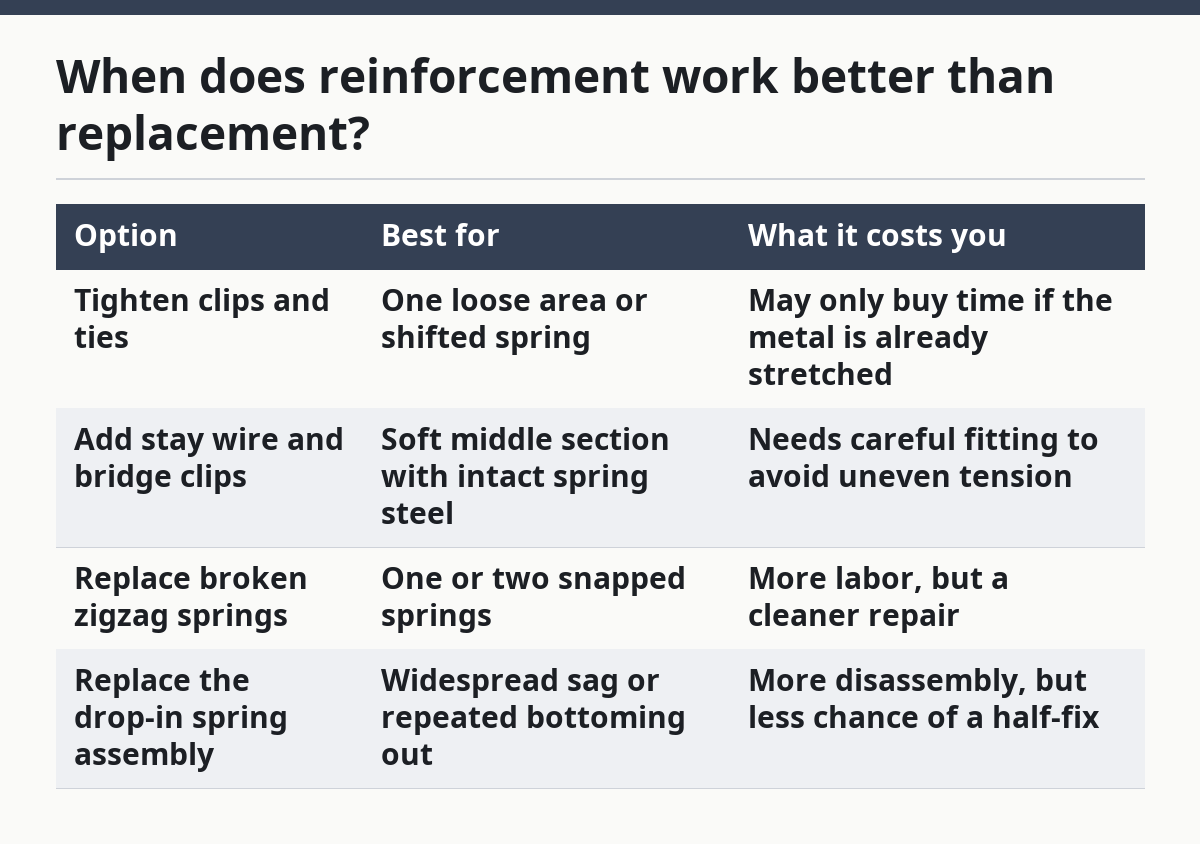
| Option | Best for | What it costs you |
|---|---|---|
| Tighten clips and ties | One loose area or shifted spring | May only buy time if the metal is already stretched |
| Add stay wire and bridge clips | Soft middle section with intact spring steel | Needs careful fitting to avoid uneven tension |
| Replace broken zigzag springs | One or two snapped springs | More labor, but a cleaner repair |
| Replace the drop-in spring assembly | Widespread sag or repeated bottoming out | More disassembly, but less chance of a half-fix |
A common mistake is trying to save a failed spring bed with foam alone. Foam can improve feel, but it does not restore the spring line’s support. Another mistake is over-tightening one section while leaving the rest loose, which creates a ridge in the seat and shifts stress to the next weak point.
How do I stop the seat from bottoming out again?
The seat stops bottoming out again when the spring bed is matched to the load it carries, not just patched where it failed. In a bariatric recliner, that means checking the entire seating span, not only the center. If the spring line is reinforced in the middle but weak at the front rail or rear anchor, the recliner will sag again at the next heavy load.
Start by confirming that the support layers are in the right order. The frame must be solid, the spring path even, the stay wire secure, and the upholstery layers fitted without slack. If any one layer is loose, the whole seat feels soft. If that support stack is in doubt, consult a professional upholsterer or furniture repair technician before putting the chair back in service. The Furniture Today repair and upholstery trade coverage repeatedly stresses that load-bearing furniture needs frame-and-suspension repairs, not cushion-only fixes. (Source: Furniture Today)
Use the upholstery webbing stretcher only where webbing is part of the design. If the seat uses sinuous wire instead of webbing as the main support, webbing tools are for adjacent support layers, not for forcing the spring into shape. That distinction matters because the wrong tensioning method can distort the spring line.
The last step is to listen and feel for movement over time. A repaired heavy-duty recliner should not creak sharply or dip more on one side after a few uses. If it does, the frame may be shifting under load, and the repair has not reached the real cause.
For broader context on heavy-duty seating, this repair sits inside the same maintenance logic as the main heavy duty recliners guide on this site. The seat has to be supported from the inside out, or the visible cushion work will not last.
What should I avoid on a bariatric recliner repair?
Avoid mixing soft repairs with a failing metal frame, because that gives the illusion of progress without fixing the load path. A cushion insert, a loose staple line, or a quick foam patch may hide the sag for a short time, but the spring system will keep taking the weight. That wastes time and usually means the seat has to be opened again.
Avoid replacing only the most obvious broken spot when the spring bed is already tired across the full width. A single new zigzag spring next to several stretched ones can create a hard ridge and a soft pocket. The repair should be even from front to back and side to side.
Avoid forcing new hardware into bent wood or torn mounting points. If the ek clips cannot hold their grip or the front rail is split, the spring will not stay aligned. In that case, the structure needs repair before the suspension can work. If you are unsure whether the rail or mounting point is sound, consult a professional before loading the chair again. The U.S. Consumer Product Safety Commission advises consumers to stop using furniture that shows structural failure or instability until it is repaired. CPSC
A final mistake is using the recliner at full load before the repair has been checked without the cushion. A quick dry test under hand pressure shows more than a fully dressed seat often will. If the support feels wrong then, it will feel worse under body weight.
FAQ
Can you add extra springs to a recliner to support more weight?
Yes, but only if the frame and spacing can accept them without distorting the seat. Extra springs can help a weak span, yet they are not a cure for a bent rail or a torn mounting point. If the added spring changes the seat line or creates a ridge, the result is worse than the original sag. If the frame is already stressed, consult a professional and use a source such as the Springs and Wire section of the Furniture Industry Training Centre. (Source: Furniture Industry Training Centre)
Why does the seat sink in the middle of a heavy duty recliner?
The seat sinks in the middle because the center span carries the most load and usually shows the first sign of stretched sinuous wire. A loose spring stay wire, failed ek clip, or broken zigzag spring often shows up there first. If the middle keeps dropping after a simple re-tie, the spring assembly may need replacement rather than another patch.
How long should a repaired spring bed last?
It depends on the part that failed and the load the recliner carries. A clip-only repair may last until the next heavy shift in weight, while a full spring replacement is designed to last much longer. If the seat is used daily and loaded near its limit, inspect it again after 30 days and then every few months.
Drafted with AI; not yet reviewed by a person.


2 thoughts on “How to Repair Sagging Springs in Bariatric Recliners”