
Last updated: November 16, 2026
Quick answer: for a 400+ lb heavy-duty recliner, choose a wall-hugger if the room is tight and the seat must sit close to the wall; choose a standard clearance model if you have open floor space and want the simpler moving path. The key difference is the track-and-glide base and its wall clearance dimension: one slides forward as it reclines, the other leans back and needs more room behind it. In this wall-hugger heavy-duty recliner comparison, I read recliner specs for clearance, frame geometry, and load language, so I can separate marketing terms from the real decision.
Key takeaways
- Wall-hugger models save rear space because the seat moves forward as it opens.
- Standard clearance recliners are simpler in motion, but they ask for more room behind the backrest.
- The big risk for heavy-duty seating is not comfort alone; it is forward track stability and center-of-gravity travel.
- If the room has a tight rear wall, the wall-hugger often wins. If the room is open and easy to place, the standard style is often easier to live with.
- Neither style is right if the floor is uneven, the user needs a very wide turning path, or the listing does not clearly state clearance and load details.
A plain comparison helps here: wall-hugger and standard clearance recliners solve the same problem in different ways. The first trades moving parts and a more complex glide path for space savings. The second keeps the motion simpler, but it asks the room to give up more depth. For a heavy-duty buyer, that trade-off matters more than a soft cushion or a shiny finish.
What is the real difference here?

The real difference is how each recliner uses space as it opens. A wall-hugger heavy-duty recliner shifts the seat forward on a track-glide base, so the backrest can recline with less rear clearance. A standard clearance recliner depends more on open space behind the chair and usually follows a more traditional pivot hinge motion.
That difference is not just about inches on a spec sheet. It changes where the center of gravity travels while the chair moves. On a heavy-duty model rated for 400+ lbs, that matters because the frame, base, and glide system have to manage load without feeling tippy when the seat begins its forward slide. A stable model should spell out the wall clearance dimension; if it does not, that missing number is a warning sign.
The wall-hugger wins on placement flexibility. The standard clearance model wins on simplicity and usually has fewer moving parts in the recline path. If the room is already crowded with a coffee table, walker, or side table, the wall-hugger tends to fit better. If there is open space and no need to tuck the seat against a wall, the standard style is often the cleaner choice.
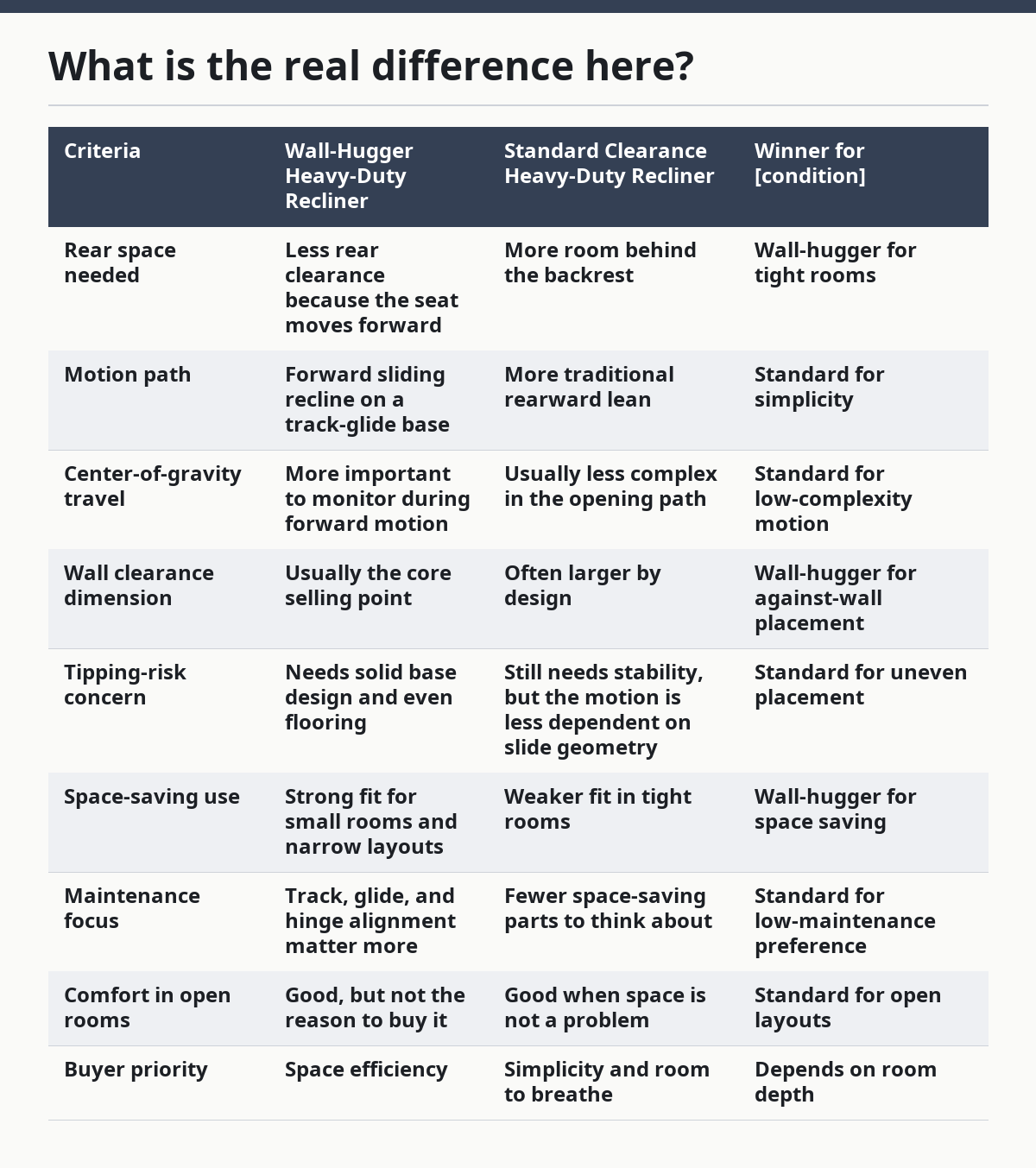
| Criteria | Wall-Hugger Heavy-Duty Recliner | Standard Clearance Heavy-Duty Recliner | Winner for [condition] |
|---|---|---|---|
| Rear space needed | Less rear clearance because the seat moves forward | More room behind the backrest | Wall-hugger for tight rooms |
| Motion path | Forward sliding recline on a track-glide base | More traditional rearward lean | Standard for simplicity |
| Center-of-gravity travel | More important to monitor during forward motion | Usually less complex in the opening path | Standard for low-complexity motion |
| Wall clearance dimension | Usually the core selling point | Often larger by design | Wall-hugger for against-wall placement |
| Tipping-risk concern | Needs solid base design and even flooring | Still needs stability, but the motion is less dependent on slide geometry | Standard for uneven placement |
| Space-saving use | Strong fit for small rooms and narrow layouts | Weaker fit in tight rooms | Wall-hugger for space saving |
| Maintenance focus | Track, glide, and hinge alignment matter more | Fewer space-saving parts to think about | Standard for low-maintenance preference |
| Comfort in open rooms | Good, but not the reason to buy it | Good when space is not a problem | Standard for open layouts |
| Buyer priority | Space efficiency | Simplicity and room to breathe | Depends on room depth |
How does a track-and-glide base change clearance?
A track-and-glide base changes clearance by moving the seat forward before the backrest takes up space. That is the point of a zero clearance big and tall recliner: the chair can sit closer to a wall because the motion happens in stages instead of all at once.
That mechanism helps when the room is boxed in, but it also raises the stakes on build quality. A forward sliding recliner track stability issue shows up fastest when the chair is loaded near its upper limit, when the floor is not level, or when the glide path is vague in the listing. The buyer should want clear language about the pivot hinge and the wall clearance dimension, not just a promise that the model “saves space.”
The upside is obvious in a small den, apartment living room, or bedroom corner. The downside is just as real: more moving geometry means more that can feel loose or awkward if the frame is cheap, the track is short, or the base is too narrow. A wall-hugger is not automatically more stable than a standard model; it just solves a different problem.
The wall-hugger is the better pick when the user has to place the recliner near a wall and still wants a heavy-duty seat. It is not the better pick for someone who has open floor space and values the simplest possible motion more than space savings.
Which heavy-duty wall-hugger should you consider?

A heavy-duty wall-hugger wins when the room is tight, the seat must sit close to the wall, and the buyer wants the best space-saving result from a large frame. It is the more practical choice for a space saving bariatric recliner in a small living room, because it tries to preserve walking room behind the seat while still supporting a bigger body.
The strength is placement. The chair can usually work in tighter layouts where a standard clearance recliner would force furniture to move. That matters when there is a shelf, side table, or foot traffic path directly behind the seat. A clear wall clearance dimension gives the buyer a real planning number, which is better than guessing from marketing copy.
The weak point is motion complexity. A track-and-glide base can feel less straightforward than a standard recliner path, and the buyer needs confidence that the center-of-gravity travel stays controlled under load. That is why a wall-hugger is not the first pick for someone who wants the simplest possible mechanism or for someone placing the seat on a slope, rug hump, or uneven floor.
This option is not for every heavy-duty buyer. It is the wrong choice if the room is already open and the user would rather have a simpler recline path than save a few inches of rear depth. It is also not the best pick if the product page hides the exact clearance story and only uses phrases like “space-saving” without a real dimension.
When does a standard clearance recliner make more sense?
A standard clearance heavy-duty recliner makes more sense when the room has room. That sounds obvious, but it is the cleanest answer: if rear depth is not a problem, the standard design gives the buyer a simpler frame and a less complicated motion path.
That simplicity matters in a heavy-duty seat. The standard layout usually has less emphasis on forward slide geometry, so there is less to think about when judging whether the model will feel planted under a 400+ lb load. It is often the safer emotional choice for a person who hates moving parts and wants the recline to feel straightforward from day one.
The trade-off is space. A standard clearance model can crowd the wall, eat into a walkway, or make the room feel boxed in. If the buyer needs a narrow rear gap or wants the recliner to live near a wall full-time, this style often becomes the wrong answer. A standard recliner can also be harder to place if the room already includes a walker, end table, or another large seat.
This option is not for small rooms, apartment corners, or users who need the back of the seat close to the wall. It is the better choice for open layouts, dedicated media rooms, and buyers who prefer the least fussy geometry over compact placement.
Which one is safer for 400+ lbs?
The safer choice is the one with the clearer structure, not the one with the louder label. For a 400+ lbs use case, the key questions are whether the frame is designed for that load, whether the base stays planted during center-of-gravity travel, and whether the listing states the wall clearance dimension plainly enough to plan the room. If the chair is going into a home with accessibility or mobility needs, a furniture professional or occupational therapist can help with fit and placement.
A wall-hugger can be safe, but only if the track-and-glide base is built well and the motion stays controlled from start to finish. A standard clearance recliner can be safe too, and its simpler geometry may feel easier to trust if the buyer has no rear space problem. Neither style should be chosen on comfort language alone.
For buyers focused on stability, the honest reading is this: the wall-hugger is a space solution first, not a safety upgrade. The standard clearance model is a motion-simplicity choice first, not a room-saving one. If stability is the main concern, the buyer should look past the style name and check how the frame, hinge, and base are described in the spec sheet.
For additional background on furniture stability and tip-over prevention, the U.S. Consumer Product Safety Commission has furniture safety guidance, and the ADA Standards for Accessible Design explain clear floor space rules that matter when a large seat has to fit into a tight room. See the CPSC furniture safety guidance at cpsc.gov and the ADA Standards at ada.gov.
The honest side-by-side
The wall-hugger wins on space efficiency, while the standard clearance model wins on simplicity. That is the short version, but the practical version is more useful: the wall-hugger is for a buyer who must place a large recliner close to a wall and still wants usable walking space. The standard clearance model is for a buyer who has the room and wants a less complicated motion path.
A lot of generic advice gets this wrong by treating the wall-hugger as the always-better heavy-duty pick. It is not. If the room is generous, the standard model may be easier to place, easier to understand, and less dependent on track geometry. If the room is tight, the standard model becomes a poor fit no matter how comfortable the seat feels in a showroom.
| Buyer need | Wall-Hugger heavy-duty recliner | Standard clearance heavy-duty recliner | Best fit |
|---|---|---|---|
| Tight rear wall | Strong match | Weak match | Wall-hugger |
| Open room | Works, but not necessary | Strong match | Standard clearance |
| Concern about forward slide stability | Needs careful spec reading | Usually easier to reason about | Standard clearance |
| Need for space-saving bariatric seating | Strong match | Weaker match | Wall-hugger |
| Preference for fewer motion concerns | Less ideal | Better fit | Standard clearance |
| Need for simple room planning | Good if clearance is stated clearly | Good if room depth is generous | Depends on room |
If the product listing does not name the wall clearance dimension, the pivot hinge, or the base type, the buyer should treat that as incomplete information. A heavy-duty recliner is too bulky to guess at.
When should you pick something else entirely?
The overall verdict flips in a few specific cases. If the room has an uneven floor, a thick rug edge, or a threshold right where the recliner will sit, neither style is a clean choice because the motion path matters too much. If the listing does not state the clearance story at all, the buyer should not guess.
The verdict also flips if the user needs the recliner moved often. A wall-hugger’s forward-slide motion can be less convenient in a room that gets rearranged a lot, because placement becomes more exact. A standard clearance model is easier to think about in a room that changes less often, especially if the wall space behind it is already available.
Another exception is the user who has plenty of room but wants the recliner close to a wall only sometimes. In that case, the extra mechanism of the wall-hugger may buy little and cost more room-planning effort. The last exception is the buyer who cares more about the cleanest recline path than the deepest space savings. For that person, the standard clearance model is the cleaner fit.
The better choice is not the one with the flashier name. It is the one that matches the room depth, the floor, and the way the seat will actually be used.
The verdict: which one to choose and why
Choose wall-hugger if the recliner must sit close to a wall, the room is tight, and you need a space-saving big and tall seat with a stated wall clearance dimension. Choose standard clearance if the room has open depth, you want the simpler motion path, and you care more about straightforward geometry than about saving rear space. Neither if the listing does not clearly explain the track-and-glide base, the pivot hinge, or the room depth needed for safe placement.
For a reader comparing these two on a phone in a real home, the recommendation is direct: wall-hugger for tight spaces, standard clearance for open rooms. That is the cleanest call, and it avoids the mistake of buying the wrong frame shape for the room.
For broader context on heavy-duty seating, the heavy duty recliners guide on this site covers the larger category and helps place this choice in the full seating lineup.
Drafted with AI; not yet reviewed by a person.

One thought on “Wall-Hugger vs Standard Clearance Heavy-Duty Recliners”