Direct answer: A heavy-duty office chair usually sinks because the gas cylinder has worn out and is leaking pressure, which is a normal wear failure after a year or more of sustained heavy use. If the sinking started almost immediately with a new or heavier user, the real problem is more likely overload — the chair’s weight rating is too low for the person using it — and a new cylinder won’t fix that for long.
Key takeaways
- Sinking has two different root causes — a worn cylinder or an overloaded chair — and they need different fixes.
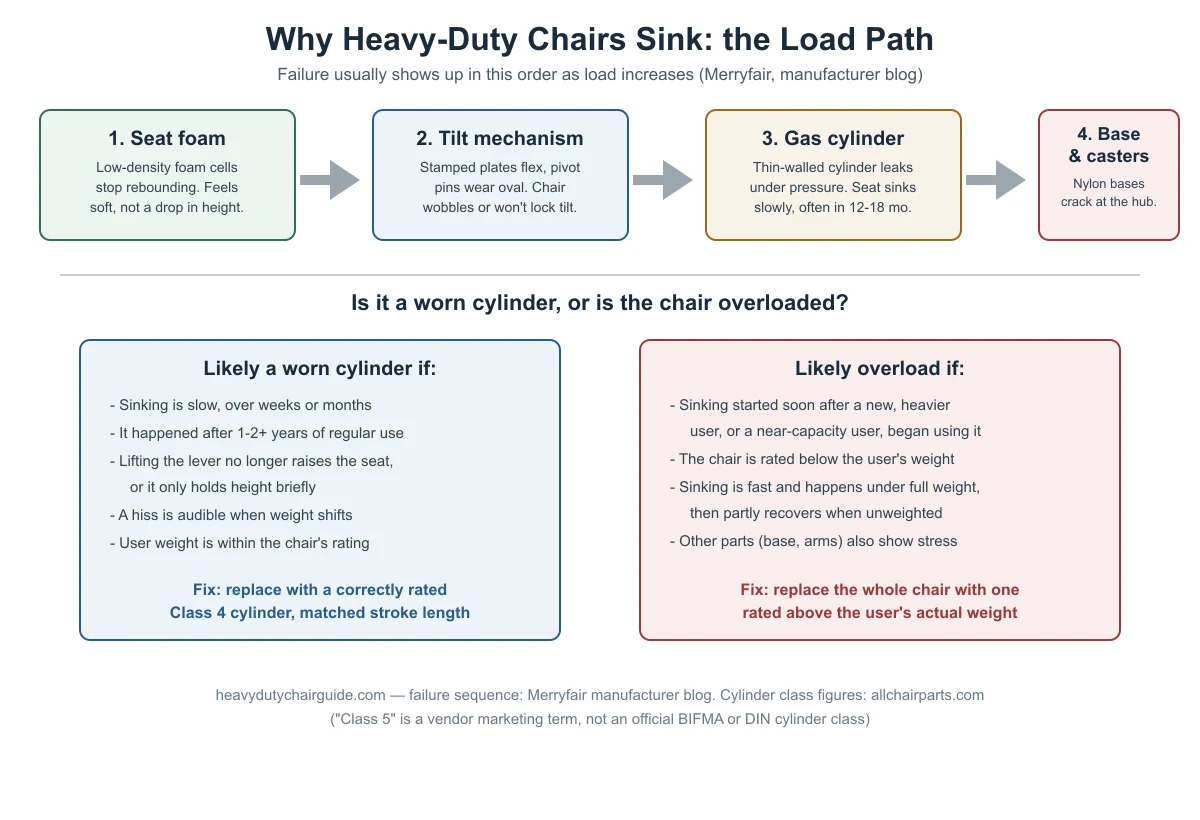
- Manufacturer failure-mode data shows chairs under sustained heavy load typically break down in a set order: foam, then tilt mechanism, then gas cylinder, then base and casters.
- Gas cylinders are rated by class, not by the chair’s advertised weight capacity — Class 3 cylinders top out around 150 kg (about 330 lb) per one chair-parts manufacturer, while its Class 4 cylinder is rated to 250 kg (about 551 lb).
- “Class 5” is not an officially recognized cylinder rating in BIFMA or DIN systems — treat it as a vendor marketing term if you see it on a listing.
- A correctly rated Class 4 cylinder, matched to the chair’s original stroke length, is the right replacement part for most 300-500 lb-rated chairs with a worn cylinder.

Why does a heavy-duty chair sink in the first place?
Every office chair holds body weight through a gas cylinder — a pressurized tube that lets the seat height adjust and absorbs the downward load when you sit. According to Merryfair, a Malaysia-based office chair manufacturer that has produced office chairs since 1982, sustained heavy load pushes a chair’s components to fail in a specific, repeatable order as thin-walled parts give way one at a time:
- Seat foam compresses first. Low-density foam cells stop rebounding after repeated compression, so the seat feels soft and bottomed-out — this is a comfort issue, not a height issue, and it’s often mistaken for cylinder failure.
- The tilt mechanism goes next. Thin stamped plates inside the mechanism housing flex, and the pivot pins wear oval, which usually shows up as wobbling or a recline that won’t hold its set position.
- The gas cylinder fails third. Thin-walled cylinders leak pressure under sustained load, producing the classic slow, progressive sinking most people associate with a “sinking chair” — typically noticeable within 12 to 18 months of sustained heavy use.
- The base and casters fail last. Nylon bases flex at the connection points and develop stress cracks, usually where a leg meets the center hub; metal bases resist this better than nylon.
Merryfair frames this as a “load path” — each stage has to survive full body weight across thousands of use cycles, and under sustained heavy load, failure tends to show up in roughly this order. That’s useful diagnostically: if your chair feels soft but hasn’t actually lost height, you’re probably looking at foam, not a cylinder problem.
Is it a worn cylinder or an overloaded chair? How to tell the difference
Both problems can feel like “the chair keeps sinking,” but they need different fixes, so it’s worth working through the distinction before buying a replacement part.
Signs that point to a worn cylinder: the sinking developed slowly, over weeks or months, after a year or more of regular use by a person within the chair’s rated weight. The lift lever may no longer raise the seat at all, or it holds height only briefly before sinking again. A faint hiss when weight shifts is also a telltale sign of a leaking seal.
Signs that point to overload: the sinking started soon after a new or heavier user began using the chair, or the user’s weight is at or above the chair’s published rating. Sinking happens quickly under full weight and may partially recover when the chair is unweighted. Other components — the base, armrests, or frame joints — may also show new stress or flex, not just the seat height.
If the signs point to overload, replacing the cylinder is a temporary patch at best — the new cylinder will be under the same excess load and is likely to wear out again. In that case, the better fix is a chair rated above the user’s actual weight; see the warning signs of an overloaded chair for the fuller checklist, and the weight capacity explainer for how those ratings are actually tested.
What gas cylinder class do you actually need?
Gas cylinders are sold by class, and the class numbers map to a weight range — though the exact kg-to-class conversion isn’t standardized across every hardware maker, so it’s worth checking the number against a named source rather than a generic chart. According to allchairparts.com, a chair-parts manufacturer and wholesaler, Class 3 cylinders are rated up to 150 kg (about 330 lb) and are the type most commonly used in standard chairs today. Its own Class 4 cylinder is rated for loads up to 250 kg (about 551 lb), built with a thicker-walled outer tube (1.5 mm) and a hardened inner tube (2.0 mm), and is available in several stroke lengths.
| Cylinder class | Rated load (allchairparts.com) | Typical use |
|---|---|---|
| Class 3 | Up to 150 kg (~330 lb) | Most standard office chairs |
| Class 4 | Up to 250 kg (~551 lb) | Heavy-duty and big-and-tall chairs, 300-500 lb chair ratings |
| “Class 5” (marketing term) | No official rating — not a recognized BIFMA or DIN class | Treat any “Class 5” listing claim with caution; ask the seller for an actual kg or lb test rating |
Other hardware sources describe Class 4 cylinders at a lower range, around 300-450 lb, using a separate DIN 4550 class system with TÜV, SGS, or LGA test marks but without a precise kg figure. There isn’t one universal kg-to-class conversion verified across every source, so if a specific weight number matters for your situation, ask the parts seller which test standard and number their “Class 4” label is actually based on, rather than assuming all Class 4 cylinders are rated identically.
For a chair with a 300-500 lb weight rating, a correctly rated Class 4 cylinder — matched to the original cylinder’s stroke length (the amount of travel between the lowest and highest seat height) — is the right replacement in most cases. Stroke lengths commonly come in a few fixed sizes; measure your current cylinder’s travel distance, or check the chair’s original seat-height adjustment range, before ordering a replacement, so the new cylinder doesn’t change how high or low the seat can go.
How do you actually replace a sinking chair’s gas cylinder?
Once you’ve confirmed it’s a cylinder problem and ordered a correctly rated, correctly sized replacement:
- Remove the chair base from the cylinder. Tip the chair on its side and strike the underside of the base near the center column with a mallet or hammer (using a block of wood to protect the finish) until the base pulls free of the cylinder’s bottom collar.
- Remove the seat from the top of the cylinder the same way — tip the chair and strike the underside of the seat plate near the center post until the cylinder’s top collar releases.
- Press the new cylinder’s bottom collar into the base, and the top collar into the seat plate’s mounting socket, using firm, even pressure until both ends seat fully.
- Reassemble and test the lift lever through its full range before returning the chair to regular use.
If any step requires excessive force or the collars don’t seat cleanly, double-check that the replacement cylinder’s collar size matches your chair’s base and seat-plate fittings — cylinder collar sizes aren’t universal across every chair brand.

When should you stop using the chair instead of repairing it?
If the cylinder is leaking because of overload rather than ordinary wear, or if you’re also seeing cracks in the base, a frame that flexes visibly under weight, or a tilt mechanism that no longer locks at all, repairing one part is unlikely to hold for long. At that point, a chair with a correctly rated weight capacity for the actual user is the safer and more cost-effective fix than a cycle of part replacements. See the warning signs checklist to confirm whether you’re at that point.
Frequently asked questions
Can I just add a chair cushion instead of replacing the cylinder?
A cushion can mask the feeling of sinking temporarily, but it doesn’t fix a leaking cylinder or an overloaded chair, and it changes your seat height and posture in ways that can cause other ergonomic problems. Diagnose and fix the actual cause instead.
How long should a gas cylinder last under heavy use?
There’s no single universal lifespan figure that applies to every cylinder and every load level — it depends heavily on the cylinder’s class relative to the actual weight and hours of use it carries. Manufacturer failure-mode data indicates noticeable sinking from a worn cylinder commonly appears within 12 to 18 months under sustained heavy use, but a correctly rated cylinder under moderate use can last considerably longer.
Is it cheaper to replace the cylinder or buy a new chair?
A correctly rated replacement cylinder is usually far cheaper than a new chair, but only if the rest of the chair — frame, base, tilt mechanism — is still in good condition. If you’re also seeing wobbling, stress cracks in the base, or creaking from the frame, replacing just the cylinder may not solve the underlying problem; see the wobbly chair troubleshooting guide for those other failure points.
Why does my chair sink only when I lean back, not when sitting upright?
This points more toward the tilt mechanism than the gas cylinder — a worn tilt mechanism can lose its ability to hold a reclined position under load even while the seat height itself (controlled by the cylinder) stays correct when sitting upright. These are two separate parts with two separate failure patterns.
What does “Class 5” mean if I see it on a cylinder listing?
Treat it as a seller’s marketing label, not an industry-recognized rating. No official BIFMA or DIN cylinder class numbered 5 exists. If a listing uses that term, ask the seller for the actual tested load rating in kg or lb and which standard it was tested against before buying.
Sources
- Merryfair — Office Chairs for Heavy People (manufacturer technical blog)
- allchairparts.com — The New Class 4 Gas Lift
heavydutychairguide.com Editorial Team. Last updated: November 13, 2026.


2 thoughts on “Why a Heavy-Duty Office Chair Keeps Sinking (and How to Fix It)”