No major chair manufacturer publishes a stated safety-margin percentage on top of its weight rating. The only hard, sourced numbers available are the BIFMA reference-user figures: 275 lb for general-purpose chairs (ANSI/BIFMA X5.1) and 253-400 lb for large-occupant chairs (ANSI/BIFMA X5.11). Beyond that, buying a chair rated noticeably above your own weight — not right at it — is a sound practice, not a cited statistic.
Key Takeaways
- No manufacturer we could verify — including Steelcase, HON, Humanscale, BodyBilt, ergoCentric, Boss Office Products, and National Public Seating — publishes a specific safety-margin percentage added to its weight rating.
- The two real, sourced reference points are ANSI/BIFMA X5.1’s 275 lb reference user and ANSI/BIFMA X5.11’s 253-400 lb large-occupant range, which also requires a 22-inch-plus seat.
- Our own general practice recommendation, not a manufacturer or BIFMA figure, is to buy a chair rated meaningfully above your actual body weight rather than right at it.
- Extended sitting, frequent reclining, and multi-shift use put more cumulative stress on the same parts than light use, so those situations call for leaning toward the higher end of a rating range.
- If you already own a chair, specific warning signs matter more than the rating number alone — see our guide to an overloaded chair.

Why Isn’t There an Official Safety-Margin Percentage?
We checked specifically for this before writing this article: Steelcase, HON, Humanscale, BodyBilt, ergoCentric, Boss Office Products, and National Public Seating. None of them publishes a named buffer percentage — no “we build in 15%” or “add 20% for safety” statement from any of them.
Numbers like 15%, 20%, or 25% do show up across buying-guide blogs, but they’re repeated inconsistently from site to site with no identifiable original manufacturer statement behind them. That means those figures are not verified facts — treat any article that cites a specific manufacturer-sourced buffer percentage with caution unless it links to the manufacturer’s own statement.
What Hard Numbers Can I Actually Rely On?
The two sourced numbers you can anchor a decision to are the BIFMA reference-user weights: ANSI/BIFMA X5.1 is built around a 275 lb reference user for general-purpose chairs, and ANSI/BIFMA X5.11 covers large-occupant chairs from roughly 253 lb up to 400 lb, with a required seat width of 22 inches or more. See our full explainer on what these ratings mean for the complete breakdown of both standards.
Past 400 lb, there’s no BIFMA certification at all — bariatric chairs rated 500, 600, or 750 lb are tested in-house by their manufacturer, which is a different kind of claim than an accredited lab certification.
So How Much Capacity Should You Actually Buy?
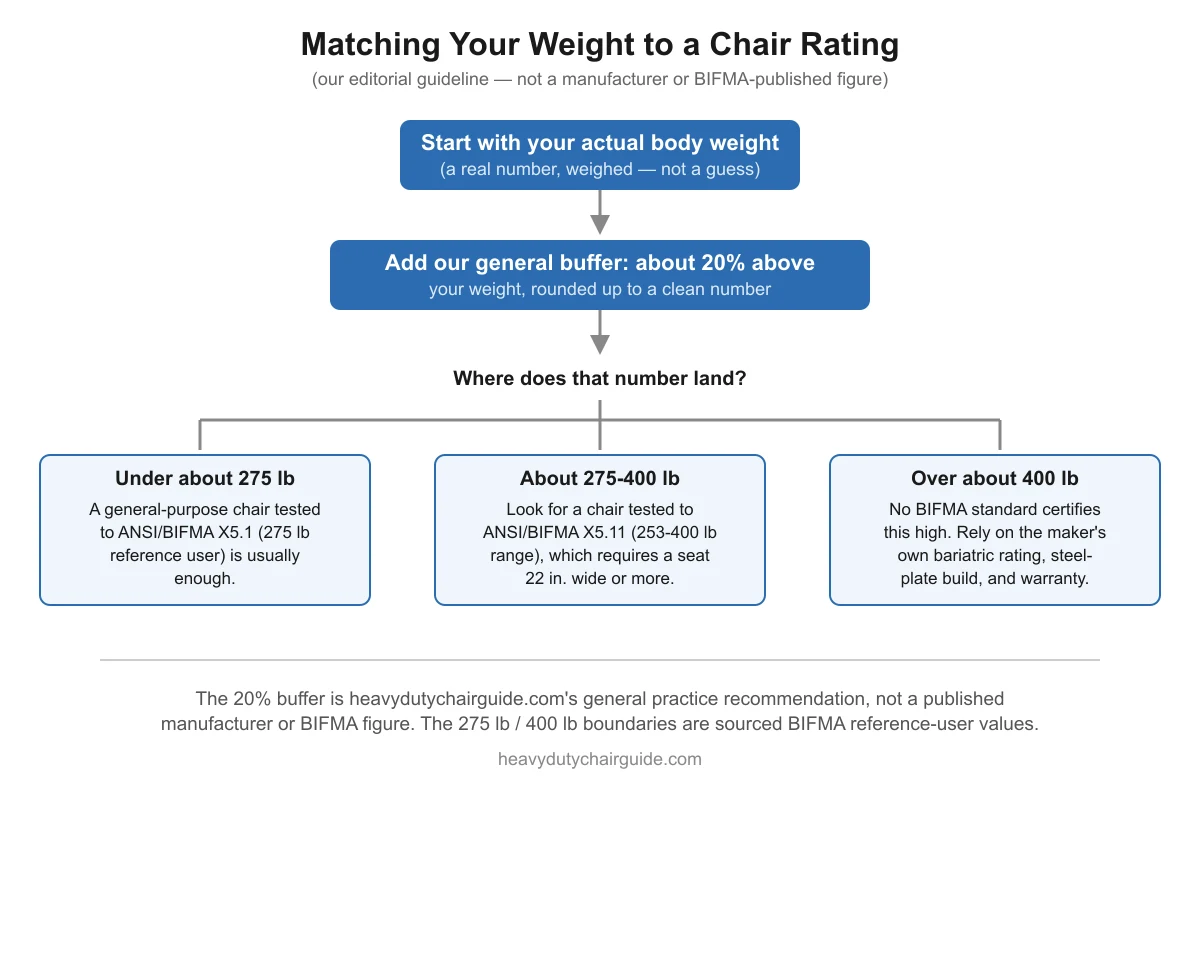
Here is our own general practice recommendation — not a published manufacturer or BIFMA figure, and clearly labeled as such: add roughly 20% to your actual body weight, then round up to a clean number, before you shop. The table below applies that guideline as a starting point, not as a verified industry standard.
| Your body weight | Our recommended minimum rating (editorial guideline, ~20% buffer) | What to look for |
|---|---|---|
| 150 lb | About 200 lb+ | Any general-purpose chair tested to ANSI/BIFMA X5.1 |
| 200 lb | About 250 lb+ | A solidly built X5.1 chair; check the cylinder class listed |
| 250 lb | About 300 lb+ | Start looking at chairs tested to ANSI/BIFMA X5.11 |
| 300 lb | About 360-400 lb | An X5.11-tested chair with a 22 in.+ seat |
| 350 lb or more | Manufacturer’s bariatric-rated line | No BIFMA certification exists above 400 lb — check the maker’s own steel-frame specs and warranty instead |
Does How You Sit Change How Much Margin You Need?
Yes, and this is where margin matters more in practice than the number on the box. According to Merryfair, a chair manufacturer that has produced office chairs since 1982, failure under sustained heavy use follows a fairly predictable order: the seat foam compresses and stops rebounding first, the tilt mechanism’s stamped plates and pivot pins wear next (often showing up as wobble before the recline stops holding), the gas cylinder leaks third (usually noticeable within 12-18 months of sustained overuse), and the base and casters develop stress cracks last.
Every stage of that sequence is cumulative — more hours sitting, more reclining cycles, and multi-shift use (for example, a chair used by more than one person across shifts) all add wear faster than light, single-shift desk use. If any of that describes your situation, lean toward the higher end of the rating range in the table above rather than the minimum.
What About a Chair Shared by More Than One Person?
If a chair is used across shifts by people of different weights — a common setup in call centers, labs, and shared workstations — size the chair to the heaviest regular user, not an average. The margin guideline above still applies, but the cumulative-wear reasoning matters even more: a shared chair accumulates cyclic load from every shift combined, so the same 12-18 month cylinder-wear timeline from sustained heavy use can arrive sooner than it would for a single person using the chair part-time.
In a shared setting, it’s also worth checking the chair’s duty-cycle or multi-shift language in its warranty, since some warranties specifically exclude 24-hour or multi-shift commercial use even when the weight rating itself is unaffected.
What If My Weight Is Right at the Edge of a Standard’s Range?
If your weight is close to 275 lb — the top of X5.1’s reference range — it’s worth stepping up to a chair tested to X5.11 rather than choosing the cheapest chair that claims to cover you. X5.11 chairs are required to have a seat at least 22 inches wide, which also tends to mean a wider, more supportive frame generally, not just a higher number on the label. Our big and tall vs. standard comparison walks through what else changes between those two categories of chair.
FAQ
Do manufacturers build in a hidden safety margin I don’t need to worry about?
We could not verify that any major manufacturer publishes or guarantees one. Don’t assume an unstated cushion exists — treat the published rating as close to the tested limit and choose your own margin deliberately.
Is it OK to buy a chair rated exactly at my body weight?
It can work for light, short-duration use, but it leaves no room for normal variables — clothing, posture shifts, reclining, or weight changes. Buying above your actual weight gives you more predictable long-term performance.
Does reclining a lot change how much capacity I need?
Yes. Reclining puts extra cyclic load on the tilt mechanism and gas cylinder specifically, the second and third parts to fail under sustained heavy use according to manufacturer failure-mode data. Frequent recliners should lean toward the higher end of any rating range.
What happens if I exceed the rating even briefly?
A single brief overage is less damaging than sustained daily overage, but repeated stress beyond the rated limit accelerates the same failure sequence — foam, then tilt mechanism, then cylinder, then base. It can also void your warranty; see our weight-capacity explainer for how ratings are tested.
Should I size up if I expect my weight to change?
If you expect meaningful weight gain, buying toward the higher end of your current range is reasonable. If you expect to lose weight, a chair that fits your current weight with our 20% guideline will still likely be appropriate afterward.
Sources
- Micom Laboratories — ANSI/BIFMA X5.1 testing summary
- Micom Laboratories — ANSI/BIFMA X5.11 testing summary
- Intertek — 2017 Update to ANSI/BIFMA X5.1
- Merryfair — how office chairs fail under heavy use
heavydutychairguide.com Editorial Team. Last updated: November 13, 2026.


One thought on “How Much Weight Capacity Do You Really Need in a Chair?”