A heavy-duty office chair warranty is worth checking on seven specific points before you buy: how many years cover the frame versus moving parts, whether single-shift use is assumed, whether exceeding the weight rating voids coverage, how “commercial use” is defined, who pays shipping and labor on a claim, the registration window, and what voids coverage outright. Read the written warranty document itself, not the ad copy, to find these answers.
Key takeaways
- Warranties commonly cover the frame for more years than the gas cylinder, casters, and tilt mechanism — check both numbers.
- Using the chair above its stated weight rating is a common, explicit reason warranty claims get denied.
- Some warranties shorten or change terms once a chair moves from home to business/commercial use.
- A warranty that only covers the part, not shipping or labor, costs more out of pocket than the headline length suggests.
- Keep your dated receipt and register the chair if required — claims are commonly denied without proof of purchase date.

Why does warranty length vary so much between heavy-duty chairs?
Warranty terms aren’t standardized the way weight-testing standards are. ANSI/BIFMA X5.1 and X5.11 set testing procedures and load numbers that a chair has to survive in a lab, but BIFMA doesn’t set warranty length or terms — those are entirely up to each manufacturer or retailer. That’s exactly why the same “5-year warranty” claim can mean very different real-world coverage from one chair to the next, depending on what’s excluded. The only way to compare two chairs fairly is to read what each warranty actually covers, not just its headline number of years.
What to check in the warranty, point by point
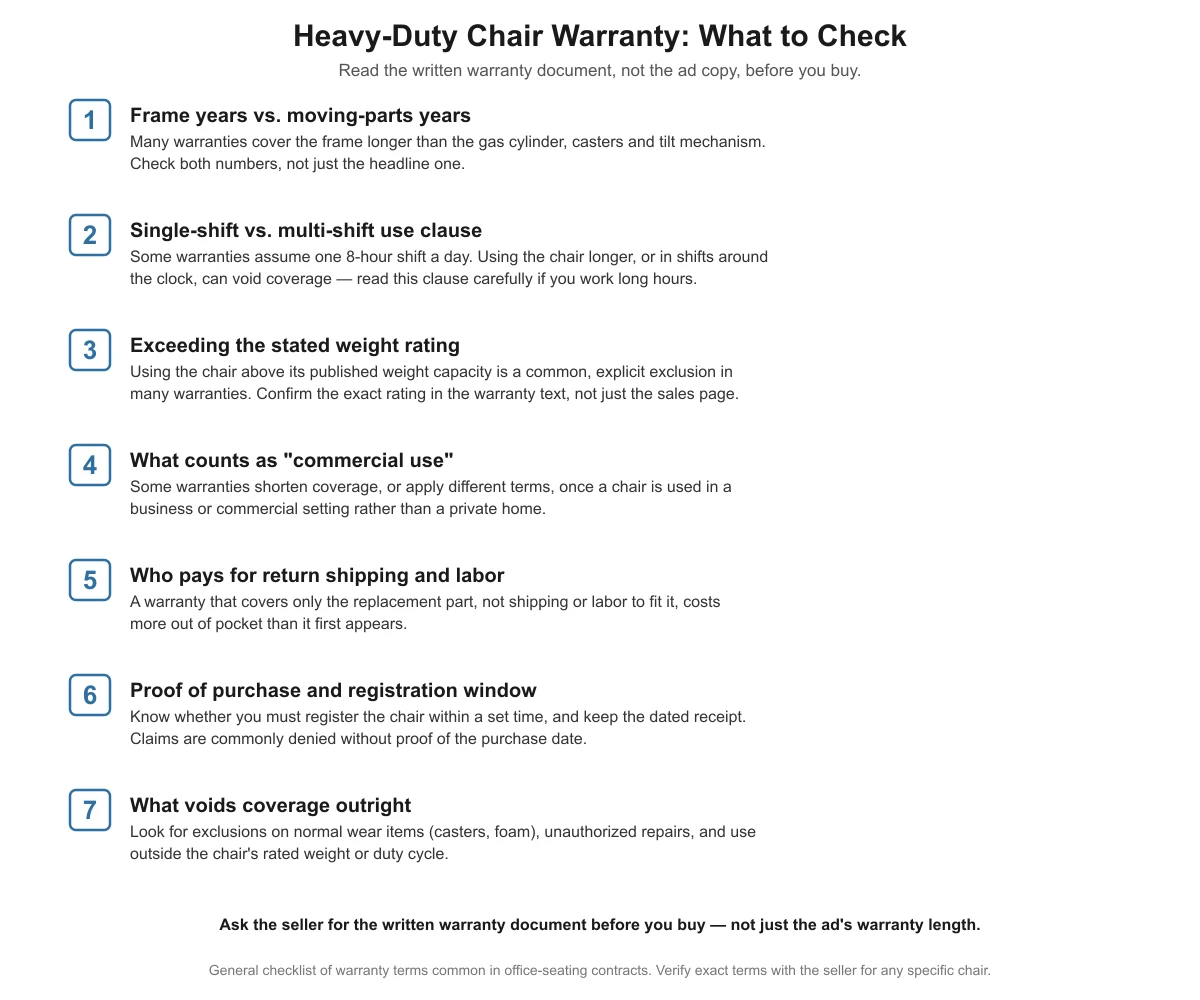
1. Frame years vs. moving-parts years
Many warranties split coverage: one length for the frame (the part least likely to fail) and a shorter length for parts that wear from motion and load — the gas cylinder, casters, and tilt mechanism. A chair advertised as having a “10-year warranty” based on the frame number alone might cover the cylinder for only 2-3 years. Ask for, or find in the warranty document, both numbers specifically.
2. Single-shift vs. multi-shift use
Some warranties are written assuming one person uses the chair for one roughly 8-hour shift per day. If the chair is used longer each day, in rotating shifts, or by multiple people across a 24-hour period, that can fall outside the warranty’s assumed use pattern and affect a claim. This matters more for a shared workstation or a long-hours home office than for typical single-shift office use.
3. Exceeding the stated weight rating
Using a chair above its published weight capacity is a common, explicit exclusion. This is a separate question from “safety margin” — our guide to what weight capacity ratings mean covers how that number is tested; the warranty question is simply whether the manufacturer will honor a claim if the chair was used above it.
4. What counts as “commercial use”
A chair bought for a home office can sometimes see shortened or different warranty terms once it’s used in a business setting — a shared office, a call center, a rental property. If you’re buying for anything other than a single person’s private home use, confirm the warranty explicitly covers that situation.

5. Who pays for return shipping and labor
A warranty that replaces a defective part for free but doesn’t cover shipping the old part back, shipping the new one out, or the labor to install it, can still leave you paying a meaningful amount out of pocket. Ask specifically what’s included beyond “the part.”
6. Proof of purchase and any registration window
Some warranties require registering the chair within a set window after purchase (30 or 90 days, for example) to activate full coverage. Even when registration isn’t required, keep the original dated receipt — claims are commonly denied without proof of the purchase date, since that’s what the warranty clock counts from.
7. What voids coverage outright
Look specifically for exclusions on normal wear items (foam, casters), unauthorized repairs or disassembly, and use outside the chair’s rated weight or duty cycle. These exclusion clauses are usually where a warranty that sounded generous on the sales page turns out to cover much less in practice.
| Warranty term | Why it matters for heavy-duty use | Where to find it |
|---|---|---|
| Frame years | Usually the longest coverage; least likely to need a claim | Warranty document, usually the headline number |
| Moving-parts years (cylinder, casters, mechanism) | Shorter than frame coverage; most claims happen here | Warranty document, often a separate line or table |
| Weight-rating exclusion | Voids the claim if you exceeded the published rating | Warranty document’s exclusions section |
| Use-setting clause (home vs. commercial) | Can shorten coverage or change terms for business use | Warranty document, sometimes the fine print |
| Shipping/labor coverage | Affects real out-of-pocket cost of a claim | Warranty document or a separate service policy page |
How warranty length compares to real spec pages
Manufacturer-published terms vary by brand and are not standardized, so treat any specific number as belonging to that one chair, not the category. For example, HON’s listed specifications for its Ignition 2.0 Big & Tall chair reference “The HON Full Lifetime Warranty” as reproduced across several authorized dealer listings — a different structure from a flat “5-year” term. Always confirm the current warranty length and terms directly with the manufacturer or an authorized seller before buying, since terms can change between model years.
A warranty document you can check directly: Steelcase’s own Limited Lifetime Warranty for Americas covers chair frames, seat shells and bases for “the normal expected life of the product,” but lists a shorter 12-year exception for the parts that do the most work — pneumatic cylinders, casters and glides, and mechanisms — a real example of the frame-vs-moving-parts split described above. The same document states coverage is valid “regardless of shift usage,” a concrete counter-example showing not every brand narrows warranty terms for multi-shift use; always check the exact wording on your own chair rather than assuming one brand’s approach is universal. That warranty also only covers units bought through Steelcase or an authorized reseller for business use — retail consumer purchases fall under a separate Limited Lifetime Consumer Warranty document instead, a real example of warranty terms depending on the purchase channel rather than only the use setting.
If you’re comparing a big-and-tall chair against a standard one on more than just warranty, see our big-and-tall vs. standard comparison.

A simple pre-purchase checklist
If any of these warning signs show up while the chair is still within warranty, it’s worth filing a claim before the coverage window closes — see our ranked checklist of overload warning signs for what to look for and when to act.
FAQ
Does a longer warranty always mean a better chair?
Not necessarily. A long frame warranty paired with a short moving-parts warranty can still leave the parts most likely to fail (cylinder, casters, mechanism) with weak coverage. Compare both numbers, and the exclusions, rather than judging by the single headline year count.
Will my warranty be voided if I’m slightly over the chair’s weight rating?
That depends on the specific manufacturer’s written terms, which this guide cannot state as a universal number — exceeding the published rating is a common, explicit exclusion in many warranties, so confirm your exact chair’s rating and the warranty’s exact wording rather than assuming any margin is allowed.
What should I do before filing a warranty claim?
Gather your dated proof of purchase, confirm the chair was registered if required, and document the specific problem (photos of a crack, a note of when sinking started) before contacting the seller or manufacturer. Claims move faster with this ready up front.
Does the warranty cover normal wear like flattened foam?
Usually not. Most warranties explicitly exclude normal wear items such as foam compression and caster wear, reserving coverage for manufacturing defects and structural or mechanical failure under normal use. Check the exclusions section to confirm for your specific chair.
Sources
- Micom Laboratories — ANSI/BIFMA X5.1 general-purpose chair testing summary
- Micom Laboratories — ANSI/BIFMA X5.11 large-occupant chair testing summary
- Steelcase — Limited Lifetime Warranty for Americas (manufacturer’s own warranty document)
HON’s “Full Lifetime Warranty” reference in this article is based on specifications reproduced consistently across multiple independent authorized-dealer listings, not a direct hon.com page read, per our research notes.
heavydutychairguide.com Editorial Team. Last updated: November 13, 2026.