
Last updated: November 15, 2026
Quick Answer: Manufacturers usually prove a power lift recliner’s weight capacity with at least three checks—static proof loading, actuator stall-force testing, and repeated cycle testing—rather than a single sit-down test. In the topic How Manufacturers Test Weight Capacities of Power Lift Recliners, bariatric lift chair load proof testing stresses the frame, lift mechanism, and upholstery support points on purpose so the maker can see where the structure holds, bends, or fails before a customer ever uses it.
What exactly gets tested?
Manufacturers test the parts that carry load when a person sits, reclines, and rises, not only the number on the label. That means the seat base, back frame, arm structure, lift mechanism, and mounting points all get attention, often under a static load test rig.
A typical test plan separates three questions. First, can the structure hold a heavy load without permanent bend? Second, can the actuator deliver enough force to raise the seat through the lift range? Third, can the recliner survive repeated use over many cycles without loosening, cracking, or drifting out of alignment? Those are different failures, and a chair can pass one while failing another.
This is why a weight rating is not the same thing as “it lifted once.” A lift chair can move a load one time and still have weak welds, a soft seat deck, or a motor that stalls when the mechanism is hot. A serious test program looks at the whole system, not just the motor sticker.
For medical and safety context, lift chairs sold as an FDA class II medical device sit in a more controlled category than ordinary living-room seating (FDA.) That does not mean every model has the same proof load, but it does mean manufacturers should treat the capacity claim as a safety claim and consult a qualified professional or the product’s test documentation before relying on it.
How do manufacturers run a static proof load test?
Manufacturers run a static proof load test by placing a known load on the chair and holding it long enough to expose weak points. The load is set on the seat and sometimes on the footrest or arm area, then the frame is checked for visible damage, cracking, or lasting deformation.
A common procedure looks like this:
-
Set the chair in the test position. The chair is usually placed in a neutral seated position or another defined angle so the load lands on the intended structure. The result should be a repeatable setup, not a hand-measured guess.
-
Apply the proof load with calibrated weights or a loading fixture. The load is introduced through the static load test rig at the seat, back, or arm structure, depending on the test plan. The goal is to force the frame to carry more than normal service load without sudden failure.
-
Hold the load for a fixed dwell period. The chair stays under load for a set time, often long enough to reveal creep, fastener slip, or foam compression that affects support. A short press is not enough to tell much.
-
Inspect the frame and lift mechanism. The maker looks for bent tubing, loose screws, torn seams, welded joint movement, and changes in alignment. A pass means the structure returns to function without dangerous deformation.
-
Repeat in other load points if needed. Some designs need testing on the seat pan, arm support, or backrest because force travels differently through each part. A 150-pound seat load and a heavier side load do not punish the frame in the same way.
This test is useful, but it has a limit. A static hold shows strength under one position, not long-term life. It can miss fatigue that shows up only after thousands of lift cycles.
Why do cycle tests matter more than one heavy lift?
Cycle tests matter because real wear comes from repetition, not one hard push. A cycle endurance tester raises, lowers, and moves the chair through a set pattern again and again so the maker can see what happens to the actuator, frame joints, switches, and wiring over time.
That is where the difference between motor stall ratings and actual frame fatigue cycles becomes clear. A motor can have enough stall force to move a load once, yet the frame can still loosen after repeated lifts. The reverse can happen too: the frame may stay intact while the actuator overheats, slows, or stops delivering the same force after long use.
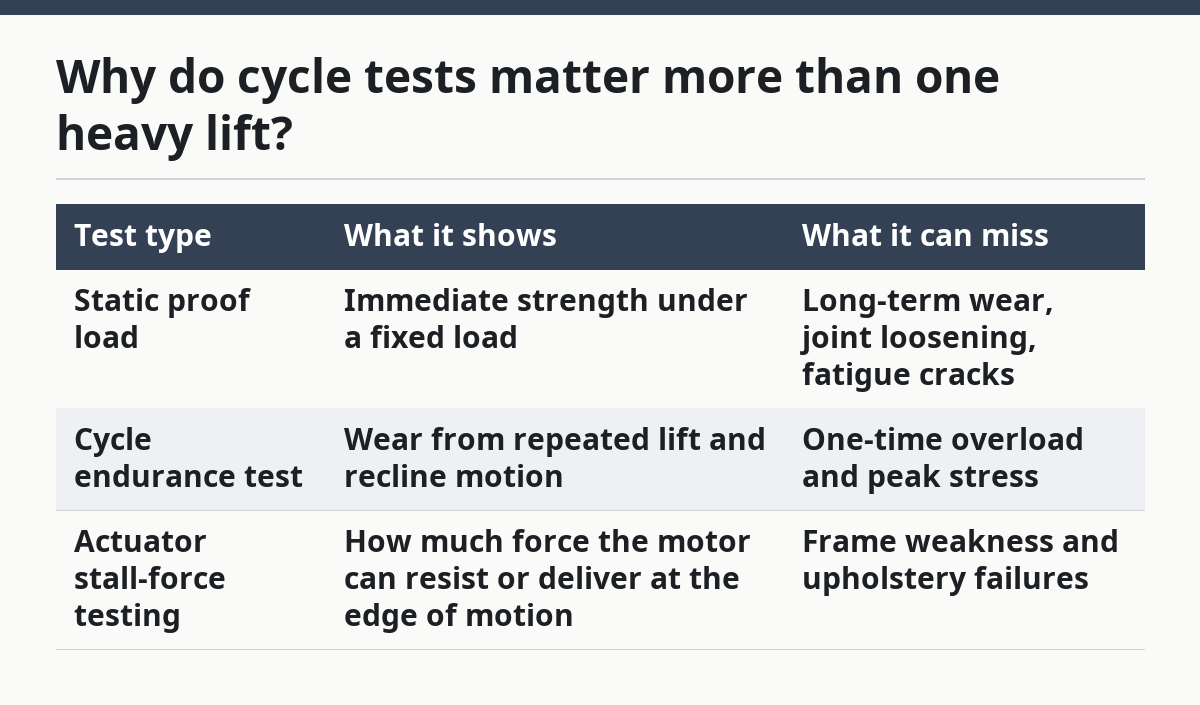
The useful comparison is simple:
| Test type | What it shows | What it can miss |
|---|---|---|
| Static proof load | Immediate strength under a fixed load | Long-term wear, joint loosening, fatigue cracks |
| Cycle endurance test | Wear from repeated lift and recline motion | One-time overload and peak stress |
| Actuator stall-force testing | How much force the motor can resist or deliver at the edge of motion | Frame weakness and upholstery failures |
A lift chair that survives 10,000+ mechanical lift repetitions has shown more than a marketing claim. It has shown that moving parts can keep working after many starts, stops, and load shifts. That still does not make every rating equal, because the tested load, angle, and duty pattern matter as much as the cycle count.
This section is where many generic articles go wrong. They should not treat “tested for durability” like a single yes-or-no label, and buyers should consult the product’s test basis or a qualified professional before treating the phrase as proof. In practice, the test question is sharper: tested at what load, in what posture, with what motion pattern, and with what pass/fail limit?
How is actuator stall force checked?
Actuator stall force is checked by loading the lift mechanism until the motor can no longer move the mechanism at the edge of its range. That tells the maker how much resistance the actuator can overcome before it stalls, slows, or draws too much current.
The test is not just about raw power. A motor may deliver enough force at the beginning of the lift, then struggle as the geometry changes and the chair approaches full rise. The load path shifts during motion, so a lift chair can feel strong at one point and weak at another. That is why the actuator check is tied to position, angle, and load placement.
A stall-force test also exposes heat and control problems. If the motor runs close to its limit, the maker may see a rise in temperature, a drop in speed, or a control cutoff that protects the unit. That can be good for safety, but it can also mean the model is near its true limit, not comfortably above it.
This is one reason a weight capacity should never be read as “the highest body weight that might sit on it once.” Capacity claims usually assume a defined use case, a normal posture, and a sensible safety margin. A person who sits hard, shifts side to side, or uses the chair many times a day can create more stress than the label suggests.
For standards context, manufacturers often design and test against medical chair safety standards and related seating protocols, then verify the specific lift mechanism with internal fixture tests. The exact protocol varies by model and intended market, which is why the label alone is not enough to judge the chair.
What standards and labels should appear?
Manufacturers should point to a standard, a test method, or a classification basis instead of only printing a capacity number. For a serious buyer, the useful signs are model-specific paperwork, an identified test method, and a rating that matches the chair’s actual construction.
A label that simply says “supports up to X” without explaining the basis is weak evidence. Better signs include mention of a proof load test, endurance cycle test, or a relevant medical device classification. If the model is sold as an FDA class II medical device, the seller should be able to identify the device class and the claim path clearly, not hide behind vague wording.
Two outside references help frame this:
- FDA medical device classification pages explain how device classes are organized and why a lift chair can fall into a regulated category when marketed for a medical function (FDA).
- BIFMA seating standards provide a recognized language for strength and durability in chairs and seating products, even when the product is not a simple office chair (BIFMA).
A careful reader should also look for plain-language clues in the product literature. Phrases like “static load test rig,” “cycle endurance tester,” and “shear load stress gauge” suggest the maker is measuring real structure, not just advertising comfort. Those terms do not guarantee quality by themselves, but they do show the company is talking in test language rather than sales language.
This page supports the heavy duty recliners guide, which can help compare broader build features, but capacity testing should always be treated as a separate question from style or cushion feel.
What mistakes make a weight rating unreliable?
A weight rating becomes unreliable when the test does not match real use. The most common problem is comparing a one-time static hold with everyday lifting, then assuming they mean the same thing.
Here are the errors that matter most:
- Testing only in one position. If the chair is loaded only in a neutral seat position, it may miss the stress that appears near full lift.
- Ignoring side load. A person rarely sits perfectly centered every time, and off-center loading can twist the frame.
- Stopping at a small sample of cycles. A mechanism may pass a short run and still loosen after many repetitions.
- Treating motor power as the whole story. A strong actuator does not save a weak frame, so buyers should consult the test basis rather than relying on power alone.
- Skipping heat buildup. Motor performance can change after repeated lifts, especially near the limit.
Each mistake costs something real. A missed side load can crack a bracket. A weak cycle plan can hide loose fasteners until the chair is in a home. A motor-only focus can produce a unit that lifts on day one and wears out early. The fix is a test plan that checks load, motion, and repetition together.
This is also where a buyer should be skeptical. A very high capacity number with no mention of proof loading, cycle endurance, or structural test method is a red flag. That does not prove the chair is bad, but it does mean the label gives less useful information than it should.
What should a buyer ask before trusting the rating?
A buyer should ask for the test basis, not just the capacity number. The useful question is, “How was this weight rating proved?” because a clear answer should mention static proof load, actuator stall force, or cycle testing.
Ask for the model name and the exact load method if possible. If the product literature mentions a static load test rig or a cycle endurance tester, that is better than a broad claim like “heavy duty.” If the seller cannot explain whether the number comes from a seat load, a frame test, or a lift mechanism test, the rating is too vague to trust.
One honest limitation is worth stating clearly: capacity testing cannot tell you whether a chair is right for every body shape or mobility need. A chair may meet a load test and still be wrong for someone who needs a wider seat, a different rise angle, or a more stable footrest. That is why weight capacity is only one part of the decision.
Overall, the safest reading is practical, not absolute. A true rating should be tied to a real test method, not a slogan. If the documentation names the load path, the test rig, and the type of stress checked, the number means more. If it does not, the number is just print.
Key takeaways
- A lift chair rating should come from more than one test, not from a single lift event.
- Static proof loading checks whether the frame can hold a fixed weight without lasting damage.
- Cycle endurance testing shows how the chair wears out after repeated lifting and lowering.
- Motor force and frame strength are related, but they are not the same thing.
- A reliable rating is backed by a defined test method, not a vague “heavy duty” label.
Are recliner weight capacities tested dynamically or statically?
Both, but for different reasons. Static testing checks whether the chair can hold a fixed load without bending or breaking, while cycle testing shows what repeated motion does over time. A strong rating usually depends on both, because one test alone leaves out either immediate strength or long-term wear.
How do I know if a lift chair weight rating is real?
A real rating is tied to a named test method, not just a sales claim. Look for mention of static proof load, cycle endurance, actuator stall force, or a recognized medical chair safety standard. If the product gives no test basis and only says “supports up to” a number, the claim is weak and should be treated with caution.
Drafted with AI; not yet reviewed by a person.



One thought on “How Manufacturers Test Weight Capacities of Power Lift Recliners”