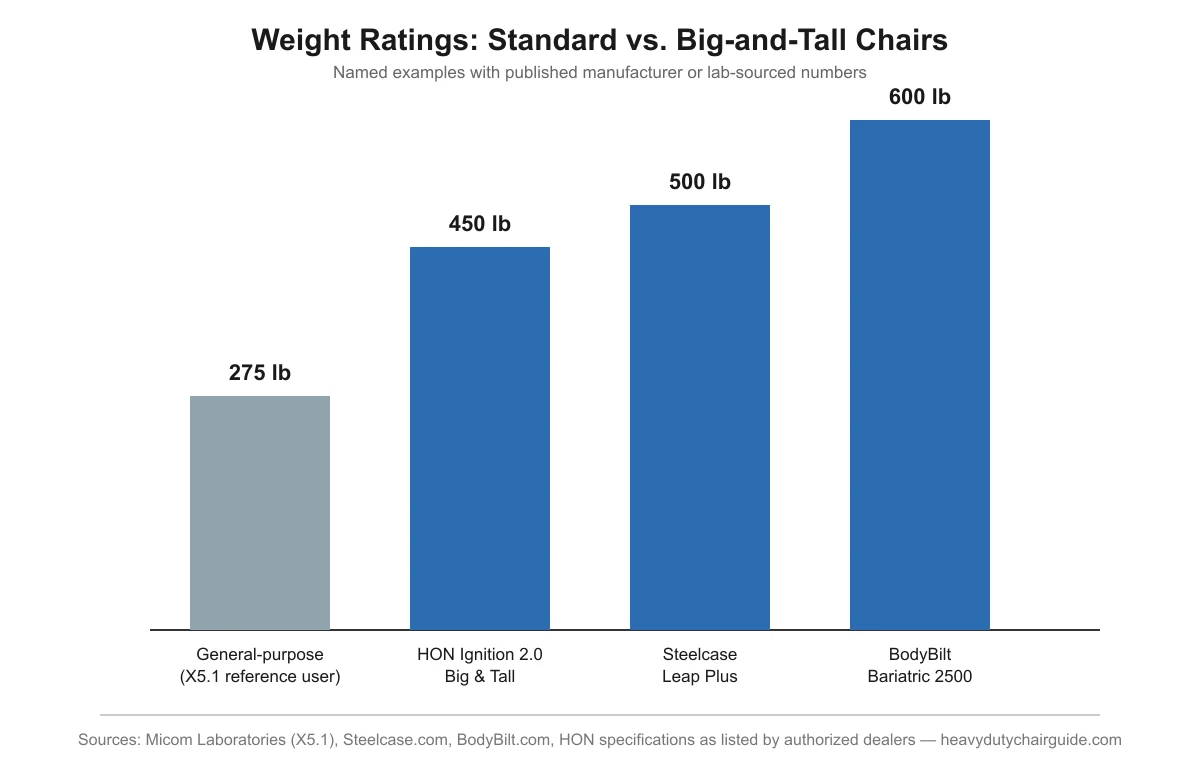
Big-and-tall office chairs differ from standard chairs mainly in frame strength, cylinder class, and weight rating — not necessarily in every dimension. Steelcase’s Leap Plus is rated for 500 lb versus the roughly 275 lb reference user that general-purpose chairs are built around, and BodyBilt’s Bariatric 2500 reaches 600 lb using a solid steel plate under the seat. But seat width and backrest height aren’t published for every big-and-tall model, so don’t assume “big and tall” automatically means a specific wider seat without checking the spec sheet.
Key Takeaways
- Big-and-tall (“large-occupant”) chairs reach higher weight ratings mainly through stronger frames, higher-class gas cylinders, and sometimes a steel plate under the seat — not just a bigger cushion.
- Steelcase’s Leap Plus is rated for up to 500 lb, the same core design as the standard Leap chair but strengthened for that capacity.
- BodyBilt’s Bariatric 2500 Series is rated 600 lb, weighs 85 lb itself, and uses a solid steel seat-pan plate plus heavy-duty cylinders.
- HON’s Ignition 2.0 Big & Tall is rated 450 lb with a published 23.5 in. wide seat, a 5-star base with dual-wheel casters, and HON’s Full Lifetime Warranty — one of the few big-and-tall models with a fully public spec sheet.
- The only dimensional number that’s actually standardized (not brand-specific) is ANSI/BIFMA X5.11’s requirement that any chair tested to it have a seat at least 22 inches wide.

What Actually Changes Between a Standard Chair and a Big-and-Tall Chair?
Three things change in a well-built big-and-tall chair: the frame, the gas cylinder, and sometimes the material under the seat. A standard office chair is typically built and tested around ANSI/BIFMA X5.1’s roughly 275 lb reference user. A big-and-tall chair needs a frame and mechanism that survive the same kinds of static, cyclic, and drop tests at meaningfully higher loads — see our full explainer on what weight-capacity testing involves for how those tests work.
What doesn’t automatically change is seat width. Unless a chair is specifically tested to ANSI/BIFMA X5.11 (which requires 22 inches or more) or the manufacturer publishes a wider seat number, a higher weight rating alone doesn’t guarantee a wider seat.
What Do Real Big-and-Tall Models Actually Spec Out To?
Steelcase Leap Plus. Steelcase’s own product page describes the Leap Plus as having “the same benefits, aesthetic appeal, and functionality of Leap with support for users up to 500 lbs.” The page does not expose exact seat-width or back-height numbers in its text, so treat those specific dimensions as no data unless you pull Steelcase’s spec-sheet PDF directly.
BodyBilt Bariatric 2500 Series. BodyBilt’s own product page lists a 600 lb weight capacity, a chair weight of 85 lb, and overall dimensions of 31 x 28 x 47 in. It’s built with a solid steel plate under the seat pan and heavy-duty cylinders. Seat width, backrest height, and gas-lift class are not listed on this page — BodyBilt directs further spec questions to its customer service line, so that’s no data rather than a guess.
HON Ignition 2.0 Big & Tall. HON’s listed specifications (reproduced consistently across multiple independent authorized dealers, since a direct fetch of hon.com returned a blank page) show a 450 lb weight capacity, a 23.5 in. wide seat, seat depth adjustable from 17.75 to 19.5 in., a floor-to-seat height range of 17 to 21.5 in., a back sized 22.75 in. wide by 24.75 in. high, a 5-star base with dual-wheel casters, and coverage under HON’s Full Lifetime Warranty.
| Spec | Standard (X5.1 baseline) | Steelcase Leap Plus | BodyBilt Bariatric 2500 | HON Ignition 2.0 Big & Tall |
|---|---|---|---|---|
| Weight rating | ~275 lb reference user | 500 lb | 600 lb | 450 lb |
| Seat width | not standardized under X5.1 | no data (not on fetched page) | no data (not on fetched page) | 23.5 in. |
| Build highlight | standard-duty frame and cylinder | Leap platform strengthened for 500 lb | solid steel plate under seat pan; heavy-duty cylinders | 5-star base, dual-wheel casters |
| Chair weight | varies | no data | 85 lb | no data |
| Overall dimensions | varies | no data | 31 x 28 x 47 in. | seat depth 17.75-19.5 in.; back 22.75 x 24.75 in.; seat height 17-21.5 in. |
| Warranty | varies by brand | no data (not on fetched page) | no data (not on fetched page) | HON Full Lifetime Warranty |
Where Are the Gaps in Published Specs?

This is worth saying plainly: Steelcase and BodyBilt both publish real, verifiable weight ratings on their own sites, but neither exposes seat width or backrest height in the pages we could read directly. That’s not unusual — many manufacturers keep detailed dimensional specs in a separate PDF spec sheet or behind a “contact us” form rather than on the main product page. If seat width matters for your situation, request the spec sheet or call the manufacturer directly rather than relying on a number from a third-party blog that may not be accurate for that specific model.
HON is the exception here: its full dimensional spec sheet is reproduced consistently across several independent authorized dealers, which is usually a sign of a real, shared manufacturer spec sheet rather than guesswork.
Does Seat Width Always Get Wider on Big-and-Tall Chairs?
Not automatically. The one dimensional rule that’s actually standardized, rather than brand-specific, is ANSI/BIFMA X5.11: any chair tested to that standard must have a seat at least 22 inches wide. HON’s Ignition 2.0 Big & Tall exceeds that at 23.5 inches. But because Steelcase and BodyBilt don’t publish seat width on the pages we checked, you can’t assume either of those chairs meets or exceeds 22 inches without confirming directly. If seat width specifically is your main concern, see our dedicated guide on how to measure and choose seat width.
Is a Big-and-Tall Chair Always the Right Choice for a Heavier User?

Usually, yes, if your weight is near or above the roughly 275 lb reference point X5.1 is built around — a big-and-tall chair’s stronger frame and cylinder reduce the risk of the failure pattern (foam, then tilt mechanism, then cylinder, then base) that heavy sustained use accelerates in a standard-duty chair. But weight rating and seat sizing are two separate questions: a shorter, heavier person may need a shorter seat height and shallower seat depth more than extra width, which a “big and tall” label doesn’t guarantee either. Whatever model you choose, check the written warranty terms before buying — our warranty guide covers what heavy-duty coverage should actually include.
FAQ
Is a big-and-tall chair just a standard chair with thicker padding?
No. The real differences that matter are structural — a stronger frame, a higher-rated gas cylinder, and in some models (like BodyBilt’s Bariatric 2500) a steel plate under the seat pan rather than foam alone over a plastic pan.
Do all big-and-tall chairs have a wider seat?
Not necessarily. Only chairs tested to ANSI/BIFMA X5.11 are required to have a seat at least 22 inches wide. Some big-and-tall models, including ones in this article, don’t publish seat width at all on their main product pages.
Why don’t Steelcase and BodyBilt publish seat width for these chairs?
We don’t know their exact reason, but it’s common for manufacturers to keep full dimensional specs in a separate spec-sheet PDF or behind customer service rather than the main product page. Contact the manufacturer directly if that number matters for your decision.
Is a 600 lb rating from BodyBilt the same kind of claim as BIFMA certification?
Not automatically — check whether the manufacturer states the rating is independently tested or lab-certified versus an in-house claim. No BIFMA standard currently certifies capacity above 400 lb, so ratings above that point come from the manufacturer’s own testing process.
Does a heavier chair (like BodyBilt’s 85 lb Bariatric 2500) mean it’s better built?
Extra weight often reflects a steel frame or seat plate rather than lighter composite materials, which can support a higher rating. It’s one data point, not a guarantee on its own — check the stated weight rating and build materials together.
Sources
- Steelcase — Leap and Leap Plus product page
- BodyBilt — Bariatric 2500 Series product page
- HON Ignition 2.0 Big & Tall specifications, as reproduced by multiple independent authorized dealers (direct fetch of hon.com returned a blank page)
- Micom Laboratories — ANSI/BIFMA X5.11 testing summary (22 in. seat-width requirement)
heavydutychairguide.com Editorial Team. Last updated: November 13, 2026.



One thought on “Big and Tall Office Chairs vs. Standard: What Really Differs”