Direct answer: Measure the widest point of your seated hips or thighs with a tape measure, add roughly 1 to 2 inches of clearance, and look for a chair with a listed seat width at or above that number. Chairs built to the ANSI/BIFMA X5.11 large-occupant standard must have a seat 22 inches wide or greater, which is a useful, verifiable reference point while shopping.
Key takeaways
- Seat width is a measurable number, not a guess — measure seated, not standing, because soft tissue spreads under seated weight.
- 22 inches is the one dimensional threshold BIFMA actually publishes: it’s the minimum seat width required for a chair tested to the X5.11 “large occupant” standard.
- Manufacturer-listed seat widths vary even among big-and-tall models — HON’s Ignition 2.0 Big & Tall lists 23.5 inches, for example, which is wider than the X5.11 minimum but not universal across brands.
- A clearance gap of roughly 1 to 2 inches beyond your measured hip width (a convention borrowed from mobility-seating sizing practice) leaves room for clothing and small shifts in position without being so wide that your arms can’t reach the armrests comfortably.
- Seat width and weight rating are separate specs — a wide seat does not guarantee a high weight rating, and vice versa.

Why does seat width need its own measurement, separate from weight capacity?
Weight capacity describes what the internal hardware — frame, gas cylinder, base — can hold up under over time. Seat width describes whether your body physically fits on the cushion without your hips or thighs overhanging the edges or pressing against the armrest posts. A chair can be rated for 500 lb and still have a seat too narrow to sit on comfortably, because those two specs are tested and built independently of each other.
This is also why “big and tall” as a category name doesn’t guarantee a specific seat width. Different manufacturers build to different widths within that category, which is exactly why measuring your own body and checking the listed number is more reliable than trusting the product category alone. This matters just as much for a shorter, heavier frame as for a taller one — see our guide for short, heavy body types for how seat width interacts with seat height and depth in that specific combination.
Seat width problems also show up differently than weight-capacity problems. An overloaded chair tends to sink, wobble, or develop stress cracks over time, as the internal hardware wears out. A too-narrow seat, by contrast, causes discomfort immediately — pressure on the outer thighs, hips pressed against armrest posts, or a feeling of perching on the edge of the cushion rather than sitting fully on it. If a chair feels wrong the moment you sit down, check width first; if it feels fine at first but gets worse over months, that points toward a weight-capacity or hardware-wear issue instead.
How do you measure your own seat width need?
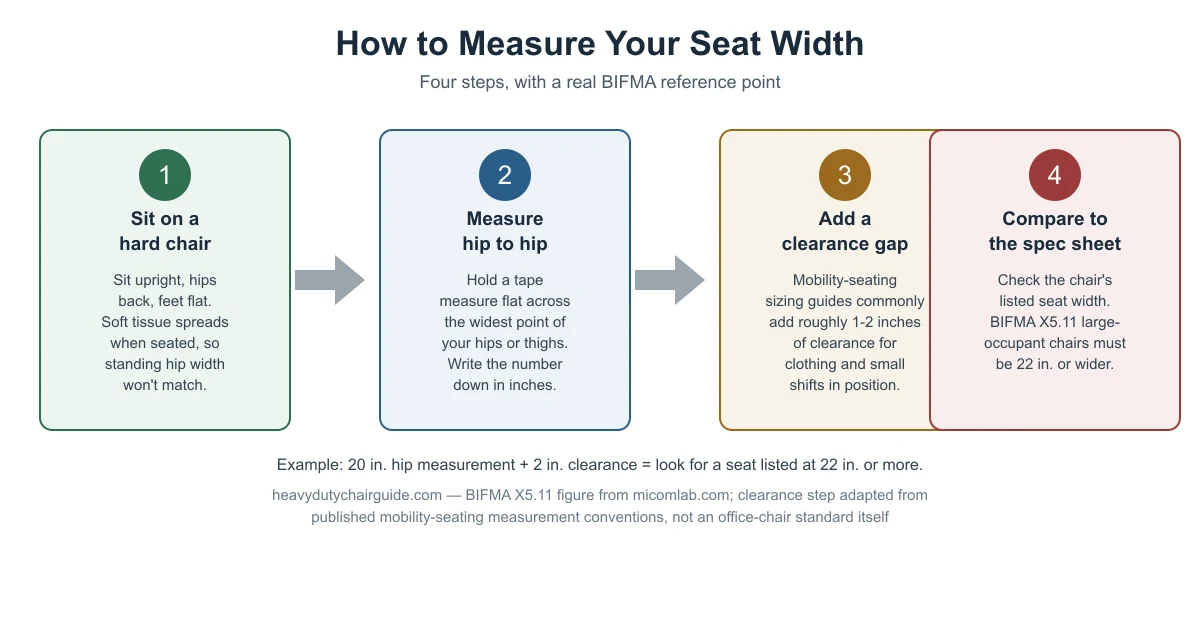
Use a flexible tape measure and a hard, flat chair (not a cushioned one, which compresses unevenly). Sit upright with your hips pushed back against the chair back and your feet flat on the floor. Hold the tape measure horizontally across the widest point of your hips or thighs while seated — not standing, since seated soft tissue spreads outward more than standing tissue does. Write down that number in inches.
From there, add a clearance allowance. Mobility-seating and wheelchair sizing guides commonly add roughly 1 to 2 inches to a seated hip-width measurement for clothing and small shifts in position; this is a convention borrowed from a related field (seating equipment sizing generally), not an office-chair-specific standard, but the underlying logic — leave a little room, but not so much that support is lost — applies the same way to an office chair seat. Your target number is your seated hip width plus that clearance.
What does the BIFMA X5.11 22-inch number actually mean?
ANSI/BIFMA X5.11 is the “large occupant” office chair testing standard, finalized in January 2015. It is the first BIFMA chair standard to include a dimensional requirement: a chair tested to X5.11 must have a seat width of 22 inches or greater. The standard uses a 99.5th-percentile male (up to roughly 400 lb) as its test basis, compared to the general-purpose X5.1 standard’s 275 lb reference user.
This doesn’t mean every chair with a 22-inch-or-wider seat is automatically X5.11-tested — it means 22 inches is the floor that standard requires, so it’s a useful benchmark number to compare against when a listing doesn’t give you much else to go on. If your own measured target width (hip width plus clearance) comes out close to or above 22 inches, you’re in large-occupant seat-width territory, not standard-chair territory.
Seat width comparison: real manufacturer numbers
Exact seat widths are not always published, so this table lists only the numbers that are verifiably attributed to a specific standard or manufacturer, rather than presenting one “typical” number as if it applies everywhere.
| Reference point | Seat width | Source |
|---|---|---|
| ANSI/BIFMA X5.11 minimum (large occupant) | 22 in. or greater (required) | Micom Laboratories, BIFMA-accredited test lab |
| HON Ignition 2.0 Big & Tall | 23.5 in. | HON’s listed specifications, reproduced consistently across authorized dealers |
| Steelcase Leap Plus (big-and-tall Leap) | no data (not published on Steelcase’s product page) | steelcase.com |
| BodyBilt Bariatric 2500 Series | no data (not published on BodyBilt’s product page) | bodybilt.com |
The “no data” rows matter as much as the filled-in ones: when a manufacturer doesn’t publish seat width, don’t guess at a number — contact the maker directly or measure a floor sample in person before buying.
What if the seat is wide enough but the armrests aren’t?
A seat can meet your measured width target and still feel tight if the armrests are fixed in place and mounted close to the seat edge. Armrests that only adjust up and down, not outward, effectively narrow the usable width of the seat because your hips or thighs press against the support posts before reaching the actual cushion edge. If you need a wide seat, prioritize chairs with armrests that adjust outward (width-adjustable) or that can be removed, rather than judging fit from the seat-width number alone.

Frequently asked questions
Should I measure standing or seated hip width?
Seated. Soft tissue spreads outward when you sit down, so a standing hip measurement will usually be narrower than your actual seated width. Measuring seated, on a hard flat chair, gives the number you actually need for a seat-width comparison.
Is a wider seat always more comfortable?
Not necessarily. A seat much wider than your clearance target can reduce support under your thighs and push the armrests out of comfortable reach. The goal is a seat that matches your measured width plus a small clearance allowance, not the widest seat available.
Does seat width affect weight capacity?
Not directly — they’re tested and built separately. A wide seat pan can still sit on a frame, cylinder, and base that aren’t rated for heavier sustained loads. Check the weight capacity explainer as a separate step.
Why don’t all big-and-tall chairs list the same seat width?
“Big and tall” is a marketing category, not a regulated spec. Each manufacturer sets its own seat width within that category — HON’s Ignition 2.0 Big & Tall lists 23.5 inches, for example, but other big-and-tall models can be narrower or wider. Always check the individual listing. See the big-and-tall vs. standard comparison for more on how these categories differ.
What should I do if the seat width isn’t listed anywhere?
Contact the manufacturer directly, or test a floor sample in person before buying. Don’t assume a seat width based on the chair’s overall category name or price point — those aren’t reliable substitutes for the actual measurement.
Sources
- Micom Laboratories — ANSI/BIFMA X5.11 testing summary
- Steelcase — Leap Plus product page
- BodyBilt — Bariatric 2500 Series product page
heavydutychairguide.com Editorial Team. Last updated: November 13, 2026.